

 CURRENT EDITION
EU edition · Rules, worked cards & common mistakes
How to play Two-player Briscola: rules and examples
Learn two-player Briscola with trump ranks, free discards, drawing order and card-point scoring, plus an illustrated trick showing how a low trump wins.
Learn with a physical deck and no money at stake. Knowing the rules does not establish legal permission to gamble.
- Players
- 2
- Deck
- 40 cards: remove eights, nines and tens from a standard pack
- Goal
- Capture at least sixty-one of the pack’s one hundred twenty card points.
Briscola has a small hand and a striking freedom: the follower need not follow suit or trump. This makes it a useful contrast to Bridge, Spades and Belote. The lesson uses two players and a single-deal result. Italian coins, cups, swords and batons can be replaced by the four familiar French suits; retain one consistent correspondence throughout the game.
Play a practice round, step by step
- Deal three cards each. Expose the next card to identify the trump suit, then place the remaining stock across it so its identity remains visible. The exposed card will be drawn last.
- The non-dealer leads one card. The other player may play any card from hand. There is no obligation to follow the led suit, to trump, or to win when able.
- A trump beats every non-trump. Between two trumps, or two cards in the led suit, the higher-ranked card wins. If the follower plays another non-trump suit, the lead wins regardless of rank.
- The trick winner collects both cards, draws first from the stock and leads next. The loser draws second. When the stock is empty, continue playing the remaining hands without replenishment.
- After every card has been played, total the values in the captured piles. Sixty-one or more wins; sixty each is a draw. For repeated games, agree a number of deal wins before starting rather than inventing a target mid-match.
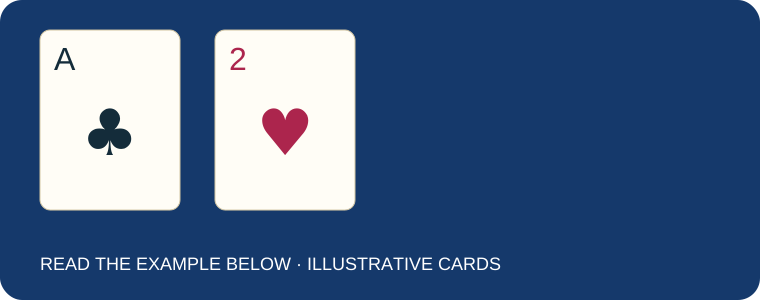
The first player leads the club ace and the follower uses the heart two. Because hearts are trump, the two wins and collects eleven card points: eleven from the ace and zero from the two. Change the follower to a diamond king, keeping hearts as trump, and the club ace wins instead. The diamond king cannot win simply by being a picture card. If the follower has a club but prefers the heart two, that is still legal in basic Briscola. As a scoring check, captured totals seventy-three and forty-seven add to one hundred twenty; the first player wins even if they took fewer tricks.
Ranks and points
Within each suit the order is ace, three, king, queen, jack, seven, six, five, four, two. Values are eleven for an ace, ten for a three, four for a king, three for a queen and two for a jack; the remaining cards score zero. In an Italian pack, horse occupies the queen’s position and knave the jack’s.
A card’s ability to win and its contribution to the score are related but not identical. A low trump can win a valuable ace while itself adding no points. A pile with many tricks can therefore lose to a smaller pile containing more valuable cards. There is no extra reward merely for winning the final trick in the basic game described here.
A first practice session
Keep three separate spaces on the table: current trick, captured cards and stock. Before drawing, both players name the winner. This prevents the familiar mistake of taking a replacement card before establishing who has first choice from the stock. Leave the exposed trump visible until its actual draw; it is information shared by both players, not a card already belonging to one hand.
Use a short sorting exercise before a full deal. Arrange one suit in ordinary numerical order, then rearrange it into Briscola order. The three makes the largest jump. Write the point values underneath and notice how the seven outranks the six while both score zero. This explains why comparing only printed numbers fails in some tricks and comparing only points fails in others.
For an open-hand demonstration, repeat one trick three times with a different follower card. First follow suit, then discard another suit, then trump. Discuss the winner in each case without calling any option automatically best. The demonstration teaches what is legal and how a trick resolves; choosing a card in a complete hidden-hand game involves additional information.
Common misunderstandings
- A three ranks above a king.
- You may discard off-suit even while holding the led suit.
- Count card values, not the number of tricks, to decide the deal.
Agree the variant before starting
- Partnership Briscola requires agreement about permitted communication.
- Five-player Briscola Chiamata adds an auction and hidden partner.
Rules and further reading
Educational synthesis with AI assistance. Source check: not recorded. This is separate from the publication and content-update dates. No federation endorsement or professional review is claimed.
All card lessons · Check local rules · Understand bonus conditions · Independent support
Your next useful step
- How to play Scopa: rules and examples
Try a table-capture game: matching values replaces trick-taking.
- How to play Classic Belote: rules and examples
Distinguish trump rank from captured point value in a partnership game.
- How to play Throw-in Durak: rules and examples
Review the attack-and-cover sequence before adding transfer options.
- Card learning library
Choose a clearly named rule set and practise with a physical deck without money at stake.