

 CURRENT EDITION
EU edition · Rules, worked cards & common mistakes
How to play Throw-in Durak: rules and examples
Learn throw-in Durak with illustrated attacks, trump defence, pickup rules, refill order and endgame examples for a clear six-card baseline.
Learn with a physical deck and no money at stake. Knowing the rules does not establish legal permission to gamble.
- Players
- 2–6
- Deck
- 36 cards: six through ace
- Goal
- Avoid being the last player holding cards after the stock is exhausted.
Podkidnoy Durak turns each round into a small contest between an attacker and a defender. Other players can join an attack by matching ranks already on the table. This guide uses individual play, six-card starting hands, and a six-card attack ceiling. It is a familiar eastern European game, but a country label does not guarantee that every family uses these exact conventions.
Play a practice round, step by step
- Remove twos through fives and jokers. Deal six cards each; expose a card to establish trumps and place the remaining stock across it, leaving its identity visible.
- The holder of the lowest trump makes the first attack. Play a card against the next active player clockwise.
- Beat each attacking card with a higher card of its suit, or with a trump if the attack is not trump. A trump requires a higher trump.
- Additional attacks must match a rank already exposed in this bout. Limit the total attacks to six and to the defender’s hand size when the bout began.
- After a completed bout, replenish hands toward six: original attacker first, other attackers clockwise, defender last. Draw the exposed trump last.
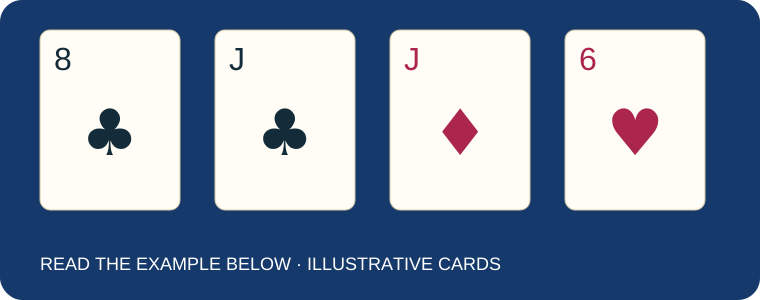
The attacker leads the club eight. The defender covers with the club jack. That jack introduces a new rank, so the diamond jack can now be added. The defender covers it with the heart six. Both attacks are beaten even though a six normally ranks below a jack: trump changes the comparison. If nobody adds an eight, jack, or six, the four cards leave play. Notice that the heart six also creates a legal rank for another throw-in before the bout closes.
Resolving a bout
If all attacks are covered and nobody adds another legal card, discard the entire table face down. The successful defender attacks next. A defender may instead concede and collect every attack and cover card; attackers may first add legal cards within the same ceiling. After a pickup, skip that defender’s attack turn.
Empty hands do not finish the game while the stock can replenish them. Once the stock is gone, players who shed their last cards leave the rotation. The final player holding cards loses; if the last two empty together in a successful final defence, record a draw. There is no standard points total.
A useful table habit
Keep each attack and its covering card together. Count attacking cards, not the total number of cardboard rectangles: three covered attacks occupy six cards but use only three places in the attack allowance. Announce a pickup before collecting anything, so everyone can check whether further additions are legal.
Before a teaching game, agree who may throw in and whether the opening bout has a special limit. This page allows every other active player to contribute; some tables restrict participation. Do not change that agreement when a defender happens to be struggling.
Common misunderstandings
- A higher off-suit non-trump does not beat an attack.
- A matching suit is not enough for a throw-in; the rank must match.
- Do not replenish the defender before the attackers.
Agree the variant before starting
- Transfer Durak adds a transfer option before defence begins.
- Partnership and first-bout restrictions require a separate agreement.
Rules and further reading
Educational synthesis with AI assistance. Source check: not recorded. This is separate from the publication and content-update dates. No federation endorsement or professional review is claimed.
All card lessons · Check local rules · Understand bonus conditions · Independent support
Your next useful step
- How to play Transfer Durak: rules and examples
Add transfer rules only after understanding ordinary defence and attack limits.
- How to play Two-player Briscola: rules and examples
Compare a trump game where following suit is not compulsory.
- How to play Euchre: rules and examples
See how the two bowers change both trump ranking and following suit.
- Card learning library
Choose a clearly named rule set and practise with a physical deck without money at stake.