

 CURRENT EDITION
EU edition · Rules, worked cards & common mistakes
How to play Transfer Durak: rules and examples
Learn transfer Durak with illustrated passing attacks, defender hand limits, refill order and endgame examples, plus the main rule variations.
Learn with a physical deck and no money at stake. Knowing the rules does not establish legal permission to gamble.
- Players
- 2–6
- Deck
- 36 cards: six through ace
- Goal
- Shed your cards while sending eligible attacks onward.
Perevodnoy Durak adds one consequential decision to Durak: before defending, you may pass an attack to the next player by adding the same rank. This guide uses individual clockwise play. Transfers are actual card plays, not a permission to point at another player. Familiarity with throw-in Durak helps, but the complete bout procedure is collected here.
Play a practice round, step by step
- Deal six cards each from a 36-card deck. Reveal the trump suit beneath the stock; ace is high and six low.
- The lowest-trump holder attacks first. The next active player either defends, picks up, or transfers before playing any cover card.
- To transfer, add a card matching the attack rank. All attacking cards move to the next active player, who may transfer again.
- Do not transfer more attacking cards than the new defender has in hand. The ordinary maximum of six attacks also applies.
- Once defence starts, cover with higher same-suit cards or trumps. Additional attacks must match a rank already on the table.
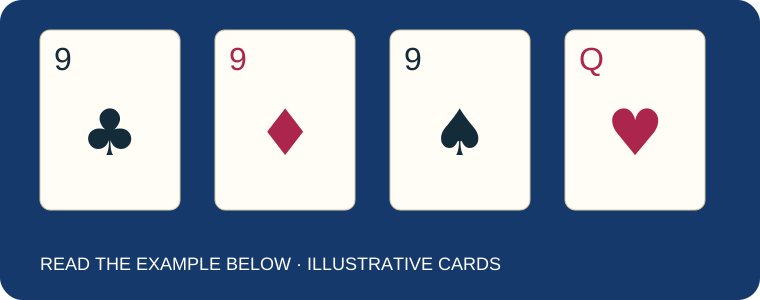
Anna attacks Boris with the club nine. Boris adds the diamond nine, passing two attacks to Clara. Clara holds five cards and adds the spade nine, passing three attacks to Anna. This is legal only if Anna has at least three cards available to face them. If hearts are trump, Anna can cover one nine with the heart queen, but then must resolve the other two by defence or pickup; that cover closes the transfer route. With only two cards in Anna’s hand, Clara’s proposed transfer would be rejected before any cards move.
Finishing and refilling
A successful defence removes the table cards from play and gives the defender the next lead. A player who takes collects attacks and covers, then loses the next attacking turn. Refill toward six: original attacker first, then other attackers clockwise, final defender last. Exception: if transfers made the original attacker the final defender, that player retains the first draw. The exposed trump is the final stock card.
After the stock ends, skip empty hands. The player left with cards is the loser, rather than someone receiving a prescribed penalty score. A final successful defence that empties both remaining hands can leave no loser. Declare the round result before shuffling, because apparently empty hands may still be due a refill earlier in the game.
Transfer decisions in practice
A transfer can return an attack to its original author, especially with two players. It does not remove any card from the table. Watch the receiving hand size before making the play: a perfectly matching card can still be an illegal transfer.
Use a clear pause before the first cover. Say either 'transfer', 'defend', or 'take', then play. Once a cover is placed, this baseline closes the transfer option for that bout. Experienced groups sometimes permit additional transfer mechanisms, but those should be named before dealing rather than inferred from the title.
Common misunderstandings
- Transfer rank must match the attacks; trump status alone is irrelevant.
- Do not transfer after laying a cover card in this baseline.
- Count the recipient’s cards before adding another attack.
Agree the variant before starting
- A travel-pass variation can allow showing a trump instead of playing it; it is excluded here.
- Two-player transfer is the same mechanism with a shorter circle.
Rules and further reading
Educational synthesis with AI assistance. Source check: not recorded. This is separate from the publication and content-update dates. No federation endorsement or professional review is claimed.
All card lessons · Check local rules · Understand bonus conditions · Independent support
Your next useful step
- How to play Throw-in Durak: rules and examples
Review the attack-and-cover sequence before adding transfer options.
- How to play Two-player Briscola: rules and examples
Compare a trump game where following suit is not compulsory.
- How to play Euchre: rules and examples
See how the two bowers change both trump ranking and following suit.
- Card learning library
Choose a clearly named rule set and practise with a physical deck without money at stake.