

 CURRENT EDITION
EU edition · Rules, worked cards & common mistakes
How to play Classic Belote: rules and examples
Learn classic Belote with trump selection, compulsory following and trumping, card points and contract scoring, plus an illustrated forty-nine-point trick.
Learn with a physical deck and no money at stake. Knowing the rules does not establish legal permission to gamble.
- Players
- 4 in two partnerships
- Deck
- 32 cards: seven through ace
- Goal
- Meet the taking partnership’s contract and accumulate the agreed match score.
Belote gives the trump jack and nine unusual power. Partners sit opposite, but the winning partnership is determined by captured point values rather than simply the number of tricks. This lesson uses clockwise classic play without sequence or four-of-a-kind declarations, retains Belote-Rebelote, and follows the named provider’s 501-point match and contract-scoring convention. Other French and regional versions differ.
Play a practice round, step by step
- Deal five cards each and expose one. Starting left of the dealer, players may accept its suit as trump or pass. After four passes, a second round may name another suit. If everyone passes again, redeal with the next dealer.
- The taker receives the exposed card and two more; everyone else receives three more. Each hand now has eight cards. The player left of the dealer leads.
- Follow suit whenever possible. When unable to follow and an opponent is winning, play a trump if available. If your partner is winning, you may discard instead. When obliged to play trump, overtrump if possible.
- The strongest trump wins; without trump, the strongest card in the led suit wins. The winner leads the next trick. Complete all eight tricks and keep each partnership’s captured cards together.
- Holding trump king and queen permits the twenty-point Belote-Rebelote announcement: name the first part when playing one and the second when playing the other. Do not confuse this pair with an ordinary non-trump king and queen.
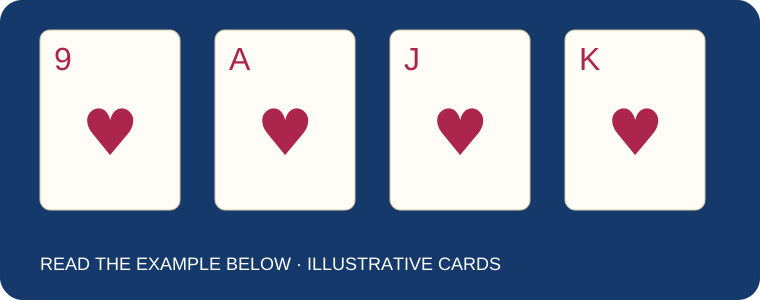
The heart nine begins the trick, followed by ace, jack and king. The jack wins despite arriving after an ace. These four cards contain fourteen plus eleven plus twenty plus four, or forty-nine card points. The king contributes four points to this trick; it does not automatically earn a Belote-Rebelote award without its queen and the required announcements. For a separate no-announcement scoring example, takers capturing eighty-eight including the final-trick award meet eighty-two, leaving seventy-four for defenders. With only eighty, they fail and defenders receive the full one hundred sixty-two. Keep these examples separate: they are not the score of one complete illustrated deal.
Two rank orders to learn
Trumps descend jack, nine, ace, ten, king, queen, eight, seven, worth twenty, fourteen, eleven, ten, four, three, zero, zero. Other suits descend ace, ten, king, queen, jack, nine, eight, seven, worth eleven, ten, four, three, two, zero, zero, zero. The final trick adds ten, giving one hundred sixty-two before Belote-Rebelote.
Under this provider convention, takers need eighty-two without Belote-Rebelote; an announced Belote-Rebelote changes the contract threshold to ninety-two including that bonus. Failed takers score no trick points, while defenders receive one hundred sixty-two; the announced twenty remains with its team. A sweep scores two hundred fifty-two before the bonus. Reach 501; if both do, compare totals, with a tied total decided by the last round winner.
A deliberate teaching deal
Before playing, build two small rank ladders with spare cards or handwritten labels. Put the jack at the top of one and below the queen on the other. Ask each player to explain which ladder applies before announcing a trick winner. This avoids trying to memorize rank and point value simultaneously during the first deal.
For score practice, count captured trumps separately from other suits, then combine the subtotals and the final-trick award. Write any Belote-Rebelote on a separate line. Only after checking the complete total should you determine whether the taking side made its contract. A table that silently changes the threshold halfway through counting is no longer using the same agreed game.
Common misunderstandings
- The trump nine outranks the trump ace.
- Following suit is required even if your partner is winning.
- A majority of tricks need not contain a majority of points.
Agree the variant before starting
- Traditional counterclockwise play and declaration games use different conventions.
- Coinche adds a numerical contract auction and is not covered here.
Rules and further reading
Educational synthesis with AI assistance. Source check: not recorded. This is separate from the publication and content-update dates. No federation endorsement or professional review is claimed.
All card lessons · Check local rules · Understand bonus conditions · Independent support
Your next useful step
- How to play Skat: rules and examples
Compare a lone declarer, special jack trumps and a game-value auction.
- How to play Contract Bridge: rules and examples
Separate the contract auction, dummy and play of the cards.
- How to play Two-player Briscola: rules and examples
Compare a trump game where following suit is not compulsory.
- Card learning library
Choose a clearly named rule set and practise with a physical deck without money at stake.