

 CURRENT EDITION
EU edition · Rules, worked cards & common mistakes
How to play Skat: rules and examples
Learn a first Skat suit contract with the auction, trump jacks, card points, matadors and game valuation, supported by an illustrated trump sequence.
Learn with a physical deck and no money at stake. Knowing the rules does not establish legal permission to gamble.
- Players
- 3 active players
- Deck
- 32 cards: seven through ace
- Goal
- Win a declared contract without overbidding its value.
Skat puts one declarer against two temporary defenders. It has several contract families and a numerical auction, so this lesson starts with a suit game before introducing Grand and Null. It is a guide to learning the structure, not a replacement for the International Skat Order. Four people may rotate a sitting-out dealer, but only three hands participate in a deal.
Play a practice round, step by step
- Deal three cards each, place two face down as the skat, then deal four each and three each. Everyone has ten cards. The player left of the dealer is forehand, followed by middlehand and rearhand.
- Middlehand offers increasing game values to forehand, who holds or passes. Rearhand then bids against the survivor. The auction winner becomes declarer; bids concern game value, not a number of tricks.
- Declarer may pick up the skat and discard two cards, or leave it untouched for a hand game. Declare a suit, Grand or Null. For a first practice deal, choose a suit contract and use the official valuation reference while bidding.
- In a suit game, all jacks are trumps above the chosen suit: clubs, spades, hearts, diamonds. Remaining cards rank ace, ten, king, queen, nine, eight, seven. Follow the led suit, treating jacks as trump; when void, discard or trump freely.
- Forehand leads the first trick regardless of declarer. The highest trump, or highest card of the led suit when no trump is played, wins and leads next. Count card points after ten tricks, including the skat for declarer.
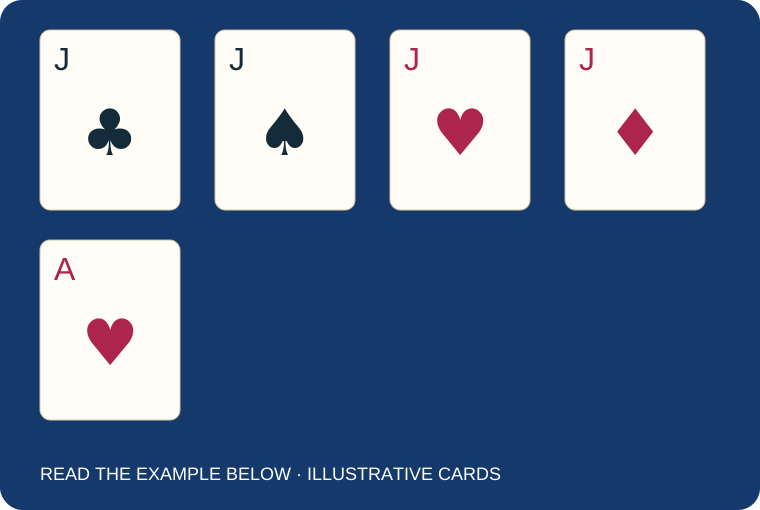
The club jack beats the spade jack, which beats the heart jack, then diamond jack, then heart ace. The pictures do not belong to their printed suits for following-suit purposes in this contract. For a valuation illustration, holding the club jack but not the spade jack, with neither hand nor skat containing the spade jack, gives with one; adding the game level makes two. A plain hearts game then has value two times ten, or twenty, before any additional achieved levels. A winning basic game at that value records plus twenty; losing it records minus forty. This example assumes no overbid and no additional announcement or multiplier.
Points are not the bid
Aces count eleven, tens ten, kings four, queens three and jacks two: the pack contains one hundred twenty card points. A basic suit or Grand game requires at least sixty-one for declarer. Suit game value uses a base of nine for diamonds, ten hearts, eleven spades or twelve clubs, multiplied by the applicable consecutive-top-trump count and game levels. Overbidding can lose a game even with enough card points.
Grand has only the four jacks as trumps and a base of twenty-four. Null has no trumps, restores ordinary ace–king–queen–jack–ten–nine–eight–seven ranking, and requires declarer to lose every trick. Its values are fixed rather than calculated like suit contracts. Schneider, Schwarz, hand and open announcements add conditions; consult the full rules before using them.
Practice the two accounting systems
Create one column headed captured card points and another headed contract value. Place an ace in the first column and write eleven. Then write a sample hearts contract value in the second. The columns answer different questions: did declarer capture enough, and did the game justify the bid? Keeping them separate prevents a common misunderstanding before any complicated auction begins.
For a trump-sorting exercise, remove the four jacks and line them up in their special order. Put the remaining cards of a chosen suit beneath them. Now change the chosen suit while leaving the jacks in place. This visible rearrangement makes it easier to understand why the club jack is trump even when hearts were declared.
Common misunderstandings
- Do not compare a bid directly with sixty-one captured points.
- A jack must follow a trump lead, not its printed suit.
- A sixty–sixty card-point split does not win a basic declarer contract.
Agree the variant before starting
- Ramsch, Kontra and pub variations are not automatic parts of this lesson.
- Use the complete valuation and overbid provisions for scored play.
Rules and further reading
Educational synthesis with AI assistance. Source check: not recorded. This is separate from the publication and content-update dates. No federation endorsement or professional review is claimed.
All card lessons · Check local rules · Understand bonus conditions · Independent support
Your next useful step
- How to play Classic Belote: rules and examples
Distinguish trump rank from captured point value in a partnership game.
- How to play Euchre: rules and examples
See how the two bowers change both trump ranking and following suit.
- How to play Contract Bridge: rules and examples
Separate the contract auction, dummy and play of the cards.
- Card learning library
Choose a clearly named rule set and practise with a physical deck without money at stake.