

 CURRENT EDITION
EU edition · Rules, worked cards & common mistakes
How to play Scopa: rules and examples
Learn Scopa with matching captures, sums, sweeps and primiera scoring, plus illustrated single-card priority and a worked end-of-deal calculation.
Learn with a physical deck and no money at stake. Knowing the rules does not establish legal permission to gamble.
- Players
- 2; partnership variations exist
- Deck
- 40 cards: remove eights, nines and tens from a standard pack
- Goal
- Collect scoring categories and sweeps to reach eleven points.
Scopa is a capture game rather than a trick-taking game. Your played card may collect one matching card or a matching sum from the table. This lesson uses a two-player game with traditional scoring categories and no extra regional bonuses. With a French-suited pack, diamonds represent coins. The queen represents the horse found in many Italian decks.
Play a practice round, step by step
- Deal three cards to each player and four face up to the table. Set the remainder aside. The non-dealer plays first. Redeal an opening table with three or four kings.
- Play one card. If an equal-value single card is on the table, take one such card; this takes priority over a sum. Otherwise take a group totaling your played value, if available. With no capture, leave the card face up.
- For captures, aces count one, two through seven their numbers, jacks eight, queens nine and kings ten. Take the played card together with the captured cards into your pile.
- Clearing the table earns a scopa, or sweep, except on the final card of the deal. Mark sweeps visibly. When hands empty, deal three more each without adding new table cards; repeat until the pack is exhausted.
- After the final play, the last player who made a capture collects any table cards remaining. These leftovers do not create a sweep. Count the deal, alternate dealer and continue toward eleven match points.
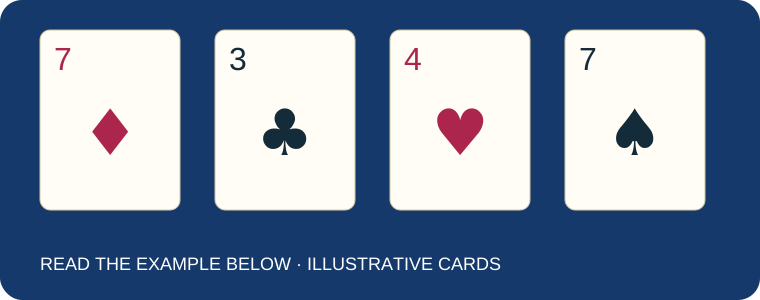
The table contains the club three, heart four and spade seven; the diamond seven is the card you play. You must capture the spade seven, not the three-plus-four combination, because the single match takes priority. Remove the spade seven from the imagined table and repeat: now three plus four is a legal capture. If those are the only table cards and this is not the deal’s final play, that capture is a sweep. For a separate primiera exercise, best cards seven, seven, six and ace total twenty-one plus twenty-one plus eighteen plus sixteen, or seventy-six. The actual primiera match point still depends on comparing the opponent’s eligible total.
The four end-of-deal categories
Award one each for most captured cards, most diamonds or coins, possession of the diamond or coin seven, and the better primiera. Tied majorities or tied primiera score neither side. Primiera uses the best card in each suit, with seven worth twenty-one, six eighteen, ace sixteen, five fifteen, four fourteen, three thirteen, two twelve and pictures ten. You need a card in every suit to compete.
Add sweeps to those category points. Finish the deal before declaring the match winner; if both reach the target together, the higher total wins, and a tied total requires another deal. A capture value of seven and a primiera value of twenty-one describe different jobs for the same card. They are not interchangeable numbers.
Two useful physical checks
Lay four labeled spaces beside the captured pile, one per suit. After a practice deal, move the best primiera candidate into each space, then compare totals. Next collect those cards back into the pile before counting the majority of cards. This makes it less likely that cards used for one scoring category will accidentally be omitted from another.
Use a face-up marker for each sweep rather than relying on memory. When the last table cards are awarded, say explicitly that this is the leftover collection. A learner can then see why the table becoming empty at that moment does not necessarily produce an extra point. Clear language prevents a procedural cleanup from being mistaken for a scoring capture.
Common misunderstandings
- An available equal single card prevents choosing a sum instead.
- Captured card counts and primiera use different measurements.
- The final leftover collection never creates a sweep by itself.
Agree the variant before starting
- Asso pigliatutto, napola and other regional bonuses change the game.
- Scopone deals larger starting hands and needs separate setup rules.
Rules and further reading
Educational synthesis with AI assistance. Source check: not recorded. This is separate from the publication and content-update dates. No federation endorsement or professional review is claimed.
All card lessons · Check local rules · Understand bonus conditions · Independent support
Your next useful step
- How to play Two-player Briscola: rules and examples
Compare a trump game where following suit is not compulsory.
- How to play Gin Rummy: rules and examples
Practise arranging sets and runs, then count only the unmatched cards.
- How to play Six-card Cribbage: rules and examples
Separate points scored during play from combinations counted afterward.
- Card learning library
Choose a clearly named rule set and practise with a physical deck without money at stake.