

 CURRENT EDITION
EU guide · Safety & player rights
How to stop gambling: practical first steps for today
You can decide to stop without first settling every debt, explaining every transaction or choosing a label for your gambling. Start with the next few hours. The aim is to create distance from gambling and connect with support, not to complete a perfect recovery plan.
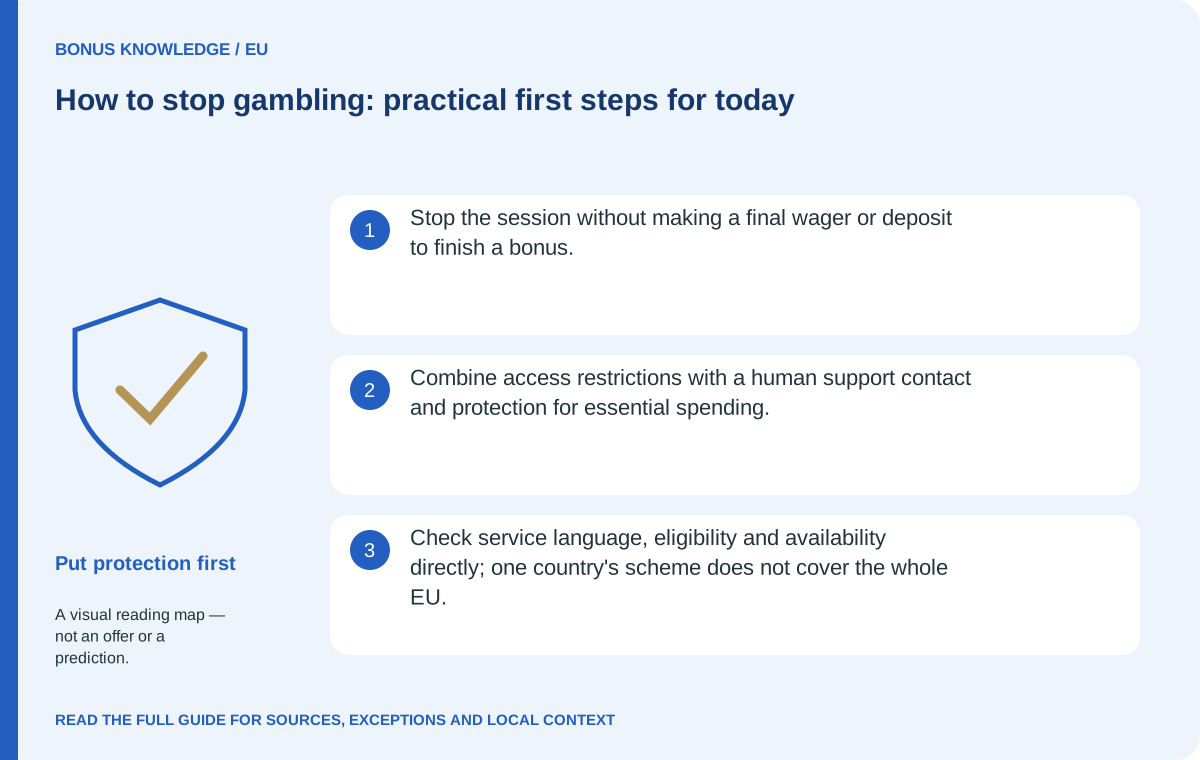
- Stop the session without making a final wager or deposit to finish a bonus.
- Combine access restrictions with a human support contact and protection for essential spending.
- Check service language, eligibility and availability directly; one country's scheme does not cover the whole EU.
End the immediate session
Close the game and put the device somewhere less convenient to use. Do not place a final wager to recover a loss, reach a round balance or finish a counter. If promotional messages are pulling you back, disable notifications and leave those channels. You can request treatment of any existing eligible funds separately; gambling more is not required to make a withdrawal question legitimate. If you are at a venue, leave the gambling area and move to a place where you can contact someone or arrange a safe journey home.
Tell one person what would help now
Choose someone you trust and make a concrete request: I want to stop gambling tonight; can you talk with me while I close the session and find support? You do not have to disclose your entire history in the first conversation. If someone close to you is unsafe or likely to threaten you, use an independent service instead. Gambling Therapy provides online support resources. Ask about the language and format you need, whether there is a charge for the particular service, and what happens after the first contact.
Put barriers between you and the next payment
Ask your bank whether it offers gambling-payment restrictions, which transactions they cover and how changes to the setting work. Availability and scope vary by bank and country; a card block should not be assumed to stop every transfer or wallet payment. Remove saved gambling payment details where practical. Identify money needed for food, housing, utilities and other essentials before making any further decisions. Seek independent local debt advice if bills or borrowing are involved. A new bonus cannot repair debt, and another loan can deepen the problem.
Use the appropriate exclusion route
Use a national scheme where one applies, alongside clearly requested operator self-exclusion when appropriate. There is no single EU register. Denmark's ROFUS, Sweden's Spelpaus, France's ANJ process and Germany's OASIS have their own coverage, identity steps and durations. Follow the official link and save confirmation securely. An ordinary account closure or deleted app is not necessarily an exclusion. Do not test a restriction by placing a wager or search for services outside its scope; tell a support adviser if you feel drawn to do that.
Plan the time previously occupied by gambling
For tonight, choose an ordinary activity with a clear beginning and end: a meal with someone, a walk, a film away from gambling feeds, or getting ready for sleep. The purpose is not to promise that the urge disappears, but to avoid leaving an open period beside the same triggers. Write a short response for an urge: leave the screen, delay action, contact the named person or service, and return to the chosen activity. If this feels hard to manage alone, seek professional support rather than treating it as a test of character.
Arrange a follow-up rather than judging the whole future
Choose a specific next step, such as contacting a local health professional, asking about counselling, or checking a support appointment tomorrow. StopSpillet offers confidential advice and treatment signposting in Denmark; France's Joueurs Info Service also supports people affected by gambling. Confirm language, residence requirements, hours and referral arrangements directly. If gambling happens again, stop that session and review the gap in the plan with support; it does not make further losses necessary. If there is immediate danger or an urgent medical need, contact local emergency services.
Common questions
Must I finish wagering before asking for self-exclusion?
No. An unfinished promotion is not an obligation. Ask separately about existing eligible money, and prioritise the protective restriction.
What if I cannot describe how much I have lost?
You can begin by describing the present concern, such as difficulty stopping or anxiety about money. A first support conversation does not require a complete financial spreadsheet.
Your next useful step
- Find a support contact
Choose a contact route, check its coverage, and ask about suitable local help.
- Gambling blocks and self-exclusion: build several barriers
Understand what access restrictions cover and where they leave gaps.
- Helping someone with gambling while protecting your own wellbeing
Find guidance for supporting someone close while keeping your own boundaries.
- First-step support guide
Read the contact options and practical first-step plan together.
Sources & further reading
Read the source alongside the explanation. Rules and published terms can change; check the current official position where you live.
- Gambling Therapy — support and recovery resources
- Gambling Therapy — responding to gambling urges
- StopSpillet — advice and treatment signposting
- Danish Gambling Authority — ROFUS
- French public-service directory — Joueurs Info Service
How this topic changes across borders
These links open the relevant local explanation. Where there is no direct equivalent, they lead to that region’s topic library.
USHow to stop gambling: practical first steps in the US →UKHow to stop gambling: practical first steps and support →