

 CURRENT EDITION
EU guide · Safety & player rights
Helping someone with gambling while protecting your own wellbeing
You do not need to diagnose someone or solve every consequence before offering help. A useful first conversation focuses on what is happening, what support the person wants and what boundaries you need. Your wellbeing matters alongside theirs.
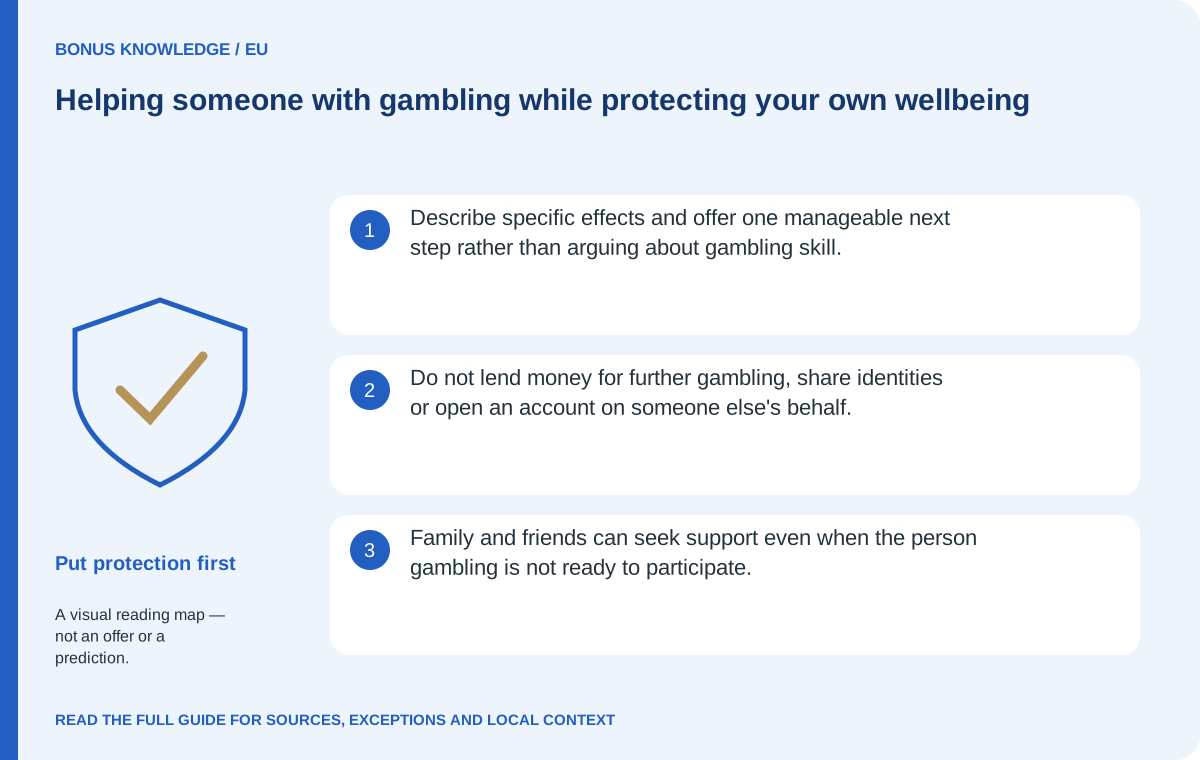
- Describe specific effects and offer one manageable next step rather than arguing about gambling skill.
- Do not lend money for further gambling, share identities or open an account on someone else's behalf.
- Family and friends can seek support even when the person gambling is not ready to participate.
Choose a calm moment and use concrete observations
If possible, talk away from a gambling session, a disputed result or an immediate demand for money. Describe what you have noticed: missed sleep, repeated requests for funds, withdrawn behaviour or distress about a bonus deadline. Use an opening such as, I am worried because gambling seems to be affecting your sleep and our bills; would you be willing to talk about support? Avoid claiming to know the full history or forcing agreement with a diagnosis. Listen, and distinguish what the person says from what you suspect.
Offer a small, specific action
Offer to sit with the person while they find a support service, help write down questions for an appointment, or accompany them to a local professional if they want that. A first message can simply say that stopping feels difficult. Gambling Therapy provides resources for family and friends as well as people concerned about their own gambling. Ask the service about language, eligibility, confidentiality and the format available. Do not promise a particular treatment, rapid recovery or access that the service has not confirmed.
Set money and identity boundaries clearly
You can care about someone without funding another session or covering an undefined stream of gambling losses. Say what you can and cannot do. Do not share payment cards, identification, passwords or a gambling account to help them claim a reward or recover money. If practical support for essentials is appropriate, discuss a transparent arrangement rather than handing over unrestricted money under pressure. Where household debts or joint accounts are involved, seek independent local financial or legal advice before making consequential changes. Avoid secret transfers or taking control of another adult's finances without an appropriate basis.
Help with protective tools without becoming the sole monitor
With the person's agreement, help locate the genuine national exclusion page or read its scope together. ROFUS, Spelpaus, ANJ's process and OASIS address different national systems; none is a universal European register. An ordinary app deletion or marketing opt-out is not the same action. The person may also ask their bank about payment restrictions or consider device blocks. Do not turn yourself into a round-the-clock surveillance system. Agree a realistic check-in and encourage independent support so protection does not depend entirely on your availability.
Respond to pressure about an unfinished bonus
If the person says another deposit is needed to avoid wasting previous effort, acknowledge the pressure without endorsing the payment. You might say, I understand that leaving it unfinished feels difficult; I will help you step away and contact support, but I will not fund more gambling. A wagering counter does not create a debt or guarantee that continued play will recover anything. Questions about remaining eligible money can be taken through the operator's account process separately. You do not need to debate game probabilities to hold that boundary.
Get support for yourself and keep safety first
People close to someone who gambles may need their own space to discuss stress, trust and finances. StopSpillet offers advice and treatment signposting in Denmark, and France's Joueurs Info Service supports those directly or indirectly affected. Check current language and access arrangements; if a local service is unsuitable, ask a health professional or international support organisation for alternatives. You can contact support even if the other person declines help. If a conversation becomes threatening, move to safety and seek appropriate assistance. For immediate danger or an urgent medical need, contact local emergency services.
Common questions
Can I seek help without the person gambling agreeing to it?
You can seek support for your own circumstances and boundaries. Do not impersonate them or access their private accounts without authorisation.
What if they gamble again after agreeing to stop?
Acknowledge what happened, maintain your boundaries and encourage renewed contact with support. You are not required to fund losses or manage the situation alone.
Your next useful step
- Find a support contact
Choose a contact route, check its coverage, and ask about suitable local help.
- How to stop gambling: practical first steps for today
Start with one manageable action without needing to finish a promotion.
- Gambling blocks and self-exclusion: build several barriers
Understand what access restrictions cover and where they leave gaps.
- First-step support guide
Read the contact options and practical first-step plan together.
Sources & further reading
Read the source alongside the explanation. Rules and published terms can change; check the current official position where you live.
- Gambling Therapy — support and recovery resources
- StopSpillet — advice and treatment signposting
- French public-service directory — support for affected people
- Cambridge Health Alliance — supporting families and friends
How this topic changes across borders
These links open the relevant local explanation. Where there is no direct equivalent, they lead to that region’s topic library.
USHelping someone affected by gambling while protecting your boundaries →UKHelping someone with gambling while looking after yourself →